
Private equity investing
What is private equity?
Private equity is a category within private markets, alongside assets like private credit, real estate and venture capital. It involves investing directly in private companies or participating in buyouts of public companies that are taken private.
Unlike public equities, private equity investments are not traded daily. Instead, capital is committed for a period of years while the investment is developed and eventually exited. As such, these investments are typically made with a long-term perspective because value is built actively over time, rather than as a result of shorter-term market movements.
Private equity sits within the broader alternative investments landscape and is typically associated with longer investment horizons and less liquidity than traditional stocks and bonds.
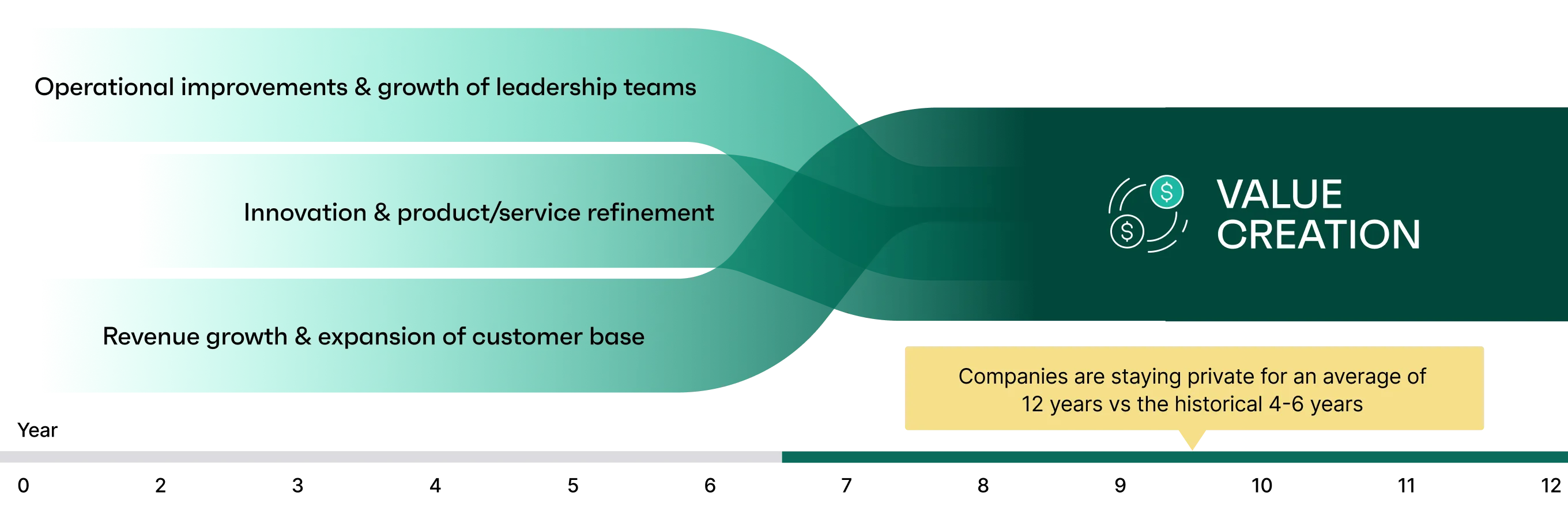
Private equity investors aim to increase the value of a business over time through a combination of strategic and operational initiatives. Common value creation levers include:

.svg)
.svg)
.svg)

Common private equity strategies and key features
Private equity investments are often accessed through pooled investment vehicles, or funds, where a fund manager selects and deploys capital across a basket of privately held companies. This approach can offer diversification in aspects like sector, size or stage of the company, but manager selection can have an impact on outcomes.
Another emerging strategy is investing in pre-IPO opportunities. Pre-IPO investing means funding companies that are nearing launch on a public exchange like the New York Stock Exchange or Nasdaq. This strategy can give investors access to growth prior to companies experiencing the pricing adjustments and volatility that can come with an IPO.
Risk considerations

Illiquidity
.svg)
Valuation uncertainty
.svg)
Concentration risk
.svg)
Manager execution risk
.svg)
Structural and regulatory complexity
These factors make due diligence and a clear understanding of the investment structure especially important.
Private equity is generally suited for long-term investors.
Typical duration
5–10+ years from initial investment to final exit
Liquidity constraints
Limited ability to redeem or sell positions during the life of the investment
Secondary markets
May exist but are often less liquid and may involve pricing discounts
Exit events
Include acquisitions, mergers, or initial public offerings (IPOs)
How private equity may fit into a portfolio

.svg)
.svg)
.svg)
How to invest in private equity
SDIRAs are specialized IRAs that allow for investment beyond traditional stocks and bonds. They follow the same tax treatment, eligibility criteria and contribution caps as standard IRAs, but are able to hold alternative assets like private equity, private credit and venture capital. Since retirement accounts are designed for long-term growth, they provide alignment with the longer timelines of private market investments.

These vehicles reduce investment minimums and allow access to specific private equity opportunities that might otherwise be inaccessible. They serve as a single fund to feed investments for institutional or high-net-worth investors. Through fund platforms, investors can typically participate in private equity offerings.

A special purpose vehicle is a legal entity created for the purpose of pooling investor capital into a single investment. In private equity, SPVs are commonly used to give multiple investors coordinated access to a specific deal or company, often with shared terms and a single entry point into the cap table. Like other private equity structures, SPVs are illiquid by nature and typically involve a defined hold period tied to the underlying investment. They follow the same SDIRA eligibility rules as other alternative assets, meaning they can be held within a self-directed IRA subject to applicable IRS guidelines. Please note that when holding an SPV inside of an SDIRA, investors should ask their custodian or a tax advisor if the investment structure could generate UBIT or UDFI.

Timely insights on private markets and retirement




Key questions to ask
Before investing in private equity, it’s important to evaluate both the opportunity and the structure by considering these questions:
What is the expected holding period, and does it align with my timeline?
How does the manager plan to create value in the underlying investments?
What are the fees and how are they structured?
How is performance measured and reported over time?
What liquidity options, if any, are available before the end of the investment?
What risks are specific to this strategy?