
Education center


Understand alternative investing

Alternative investments generally fall into several broad categories. Each includes multiple strategies and structures with unique return profiles and portfolio roles.
Private equity
Investments in privately held companies across different stages of development, from growth stage to pre-IPO.
List item one
List item two
List item three
Venture capital
Funding early-stage startups with high growth potential to power key initiatives like product development, hiring or company expansion.
List item one
List item two
List item three
Angel investors
Early-stage investing in startups, often before institutional capital enters, with the potential for significant upside if the company grows.
List item one
List item two
List item three
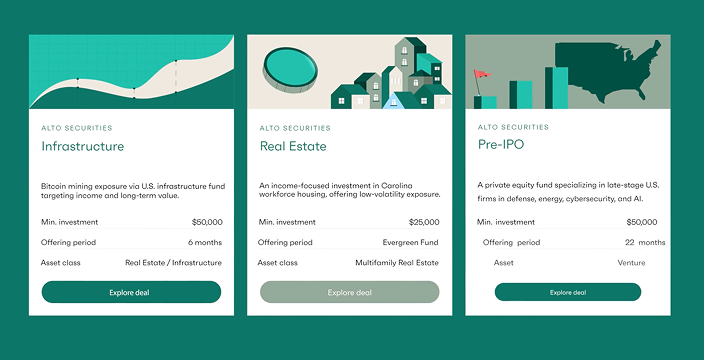
Pre-IPO
Investing in companies ahead of a public offering, typically at a later stage of private market development than venture capital.
List item one
List item two
List item three
Private credit
Direct lending to companies that provide income through interest payments.
List item one
List item two
List item three

How private market investing works
Invest in private markets for a resilient retirement
Understanding self-directed IRAs


Video library



FAQs
Traditional IRA: Tax-deferred retirement account where contributions may be tax-deductible, and earnings grow tax-deferred until withdrawal.
SEP IRA: Stands for Simplified Employee Pension IRA, ideal for self-employed individuals or small business owners to save for retirement with potentially higher contribution limits.
Roth IRA: Retirement account funded with after-tax dollars, offering tax-free growth and – subject to IRS rules – withdrawals during retirement, with potential income limitations for contribution.
This still leaves plenty of alternative investment choices. Alto has built tools into its platform to help you avoid prohibited investments, though it's always wise to consult a tax professional before moving forward with an investment.
Investing in alternatives with an Alto self-directed IRA means you can legally minimize and potentially even eliminate taxes altogether. In Traditional and SEP IRAs, taxes are typically deferred on gains until withdrawal. When investing with a Roth IRA, qualified withdrawals are generally tax-free, with applicable IRS rules to consider.
Investing with a self-directed IRA also gives you access to capital that is otherwise locked away until later in life. This means you can strategically align the long term time horizon of capital earmarked for retirement and alternative assets that have longer than typical commitment periods – an investing match made in duration heaven.
Explore other resources
Insights & research

Webinar library
Get started with Alto